My food, my health
· 24 min read

Digestion is the most important factor that keeps us happy. It depends on what we eat (including the availability of enzymes), how much fluid we drink, movement, rest, hygiene and positive thinking.
“Whatever the illness, its mother is poorly digested food.”
Chinese proverb
With this booklet we wanted to show you how correct eating leads to proper digestion and, beyond that, to a healthy body. Only then can we talk about a healthy organism.
We wish you good health!
What are enzymes?
The word ‘enzyme’ has Greek origins and means ‘to ferment’ or ‘to leaven’. Dr Eduard Buchner, a physician and pioneer in enzyme research, called enzymes ‘living yeast’, because without them there would be no movement, breathing, digestion, reproduction, maintenance of health, metabolism of substances and reactions, or a functioning immune system.
Enzymes in the human body
Enzymes are proteins or protein complexes that catalyse chemical reactions in the body, speeding them up by as much as 1,000,000 times. Each enzyme is unique and specialised, triggering a reaction only in specific substances. Interestingly, a newborn baby has more than 100 times as many enzymes as an adult.
To support the body’s vital functions we need carbohydrates, fats, proteins, minerals and vitamins, but most of them cannot be used, or are ineffective, without enzymes. After we eat, we chew our food, which breaks it down into small particles (nutrients) so that they can be absorbed and reach the cells through the bloodstream. There, other enzymes, mainly the amino acids in the body, begin building structural elements, while vitamins and minerals are ‘released’, freeing up energy. This new energy serves to renew the cells.
Digestive enzymes
Enzymes are indispensable when we digest food, release energy, and build cells and tissues. More than 4,000 enzymes have been discovered so far. Those linked to digestion and produced in the human body fall into three main types: amylase, lipase and protease. With age and an unhealthy lifestyle, their production declines steadily. All raw foods contain digestive enzymes that work together with our own. This means food is digested faster, and the less the body has to make up for an enzyme shortfall, the more energy is left over. If the body has to make enzymes in excess, it spends vital energy doing so. That is why it is worth sparing the production of digestive enzymes: add enough enzymes through food and supplements, and your body will thank you. Taking digestive enzymes supports the body’s natural defences, supports blood circulation, supports the healing of wounds, and helps keep the natural rate of cell renewal in balance!
There are three main ways to preserve and replenish enzyme levels: by eating raw food, by combining products correctly in quantity and quality, and by taking enzyme supplements.
What do I eat today?
Our busy daily lives mean we pay less and less attention to what and how we eat. The right eating rhythm is a factor of great importance.
Starting the day with one or two glasses of warm water helps wake up the body. It is ideal for breakfast to be made of fruit and raw foods, so that the body is not overloaded. Otherwise, instead of energy and vitality, we will feel heaviness and sluggishness.
During the day, with our everyday commitments, we often rush through lunch and turn to less healthy foods in the evening. All of this overloads the body and disrupts the normal secretion of enzymes, making it harder to absorb essential nutrients. As a result, we soon crave sweet and salty processed foods.
Poor quality, unhealthy combinations and an inadequate diet can lead to overload, fermentation and the development of gas or fermentation processes in the intestines.
Many people attribute digestive problems to a variety of causes, including allergies, headaches, heavy abdominal crises and bloating. The first line of defence in the intestines is the stomach acid. If the digestive process is slow and rhythmic, it can deal with most of these harmful substances, and then it removes them from the body. But we should not abuse this ‘labour force’: if our irregular eating habits keep overburdening it, it will eventually tire.
Limited ability to produce enzymes from the pancreas soon leaves undigested food to ferment in the intestines, where it can serve as a source of toxins or feed harmful bacteria. These toxins, especially those produced when proteins are rotted, are absorbed through the intestinal wall and filtered by the liver and kidneys, which must work harder to remove them.
Many people have a predisposition to digestive problems, and conditions such as bloating, slow bowel movement and intestinal problems are common. Our body is quick to signal when something is wrong.
What diseases can an enzyme deficiency lead to?
The main task of the body is to ensure it has enough nutrients to function. When we digest, dissolve and transform food into nutrients, the body needs the right enzymes. The process of making enzymes from food requires energy. If we do not supply enough enzymes, the body must use its own energy reserves to produce them, which can lead to fatigue and digestive imbalance. When it cannot make enough enzymes, the result can be a range of health concerns, such as acid reflux, gas, bloating, constipation and diarrhoea, headaches, and joint or muscle pain. Enzyme deficiency is also linked to low energy, skin problems, and to changes in weight and mood.
Health conditions
Among the statistical data, more diseases than ever are of old age, and they affect over 35% of young people. Diabetes, obesity, asthma, cardiovascular and many other diseases are among them. One of the main reasons is the lack of digestive enzymes produced by the human body. The pancreas’s production of enzymes falls by about 10% every ten years after the age of 20.
Most of the body’s immune cells are located in the walls of the intestines and in the lymph nodes. If food is not digested properly, this affects the immune defences of the body. In times of acute and chronic illness, the production of enzymes becomes more difficult, which leads to exhaustion.
A deficiency of a single enzyme can disrupt a whole cascade of metabolic reactions in the body, and in this way prevent the complete breakdown of a vital substance.
You can add the most important digestive enzymes through Enzy-Mill: /products/enzymill/
Enzyme deficiency
Constant poor eating deprives the body of important nutrients: amino acids, minerals, vitamins and essential fatty acids, because these are not available to the cells. At the same time, the body has no energy, and it quickly tires and becomes prone to depression. Some people experience psychological symptoms such as stress and irritability. Many people with low enzyme levels and digestive disturbances also show negative effects such as fear, anger, poor concentration or depression. These are often linked to poor digestion, which shows just how closely the body and mind are connected.
Correct eating
The process of enzymatic breakdown of food begins when we chew. When we chew well, we not only mix food with the enzymes in our saliva, but also allow the food’s own enzymes to remain active so they can work. Therefore, correct eating starts at the table and finishes in the toilet. The body cannot secure the necessary quantity and quality of proteins from food alone, so it is forced to use its internal reserves and begin breaking itself down. If even one of the key nutrients, such as vitamins, proteins or minerals, is not supplied properly, the following problems begin:
- Poor eating and excessive consumption of unsuitable foods, especially vitamins and minerals, are the main cause of tiredness, high blood pressure, and the early onset of diseases of the heart and kidneys;
- If vitamins are not absorbed properly, undigested particles can pass into the bloodstream through the intestinal walls alongside other nutrients. This is known as a syndrome of increased intestinal permeability and can lead to serious allergic reactions. Undigested proteins in the gut feed harmful bacteria, which produce toxins and then move to the blood, causing migraines or skin problems. When the body’s reserves of these vitamins are used up, they lead to deficiencies and diseases;
- Excessive amounts of vitamins lead to two processes: if they are absorbed, but not used, they turn into minerals and disrupt the body’s metabolism; if they are not absorbed, they lead to fermentative processes in the intestines and gas formation.
How should we eat for better health?
Before anything else, we should eat fresh vegetables, fruit and whole grains every day. The foods that are important but are best eaten in moderation are meat, dairy and sweets. We should limit fried, trans- and refined fats, sugary products, alcohol and drinks with coffee. Pay attention to the main nutrients:
Carbohydrates
Carbohydrates: they provide the body with the energy it needs. In the digestive system, simple carbohydrates are quickly converted into glucose and other monosaccharides, with the exception of fibres, which are barely digested at all.
When choosing carbohydrates, always opt for unprocessed foods such as fruit, vegetables, legumes and whole grains, and avoid refined foods such as white bread, sweets, sugary drinks and sugary snacks. Look out for carbohydrates in processed foods too.
Simple carbohydrates, such as glucose syrup, sweets and confectionery, cause significant fluctuations in blood sugar levels, which leads to an excessive insulin response, increasing hunger and the risk of weight gain. Such products are also commonly found in cafés and fast food.
Proteins
Proteins (protein-rich foods): they are the main building blocks of all cells and tissues in the body. They make up about 83% of the dry matter of muscles and 90% of the dry matter of the blood. They support the maintenance of the acid-base balance. They take part in building important structures such as immune cells, blood plasma, haemoglobin, enzymes and hormones. They are therefore needed for growth and development. Proteins are the building blocks of tissues and are necessary for transporting vitamins and minerals through the blood. Dark chocolate contains proteins that help regulate blood sugar.
Proteins can be divided into two main groups: complete and incomplete. The first contain all the essential amino acids in good proportions, while incomplete proteins lack some of them. But when two of these are combined, they can provide all the essential amino acids. Complete proteins are found in meat, fish, eggs, cheese and milk. Incomplete proteins are found in cereals, legumes, nuts and leafy green vegetables. For a complete protein from plant sources, combine legumes with cereal, cereal with seeds, nuts or yoghurt, or combine cereal with wheat, seeds, nuts or pulses.
Unmet protein needs weaken the body’s recovery processes. This leads to increased fatigue and can result in weight loss and a slower recovery from illness.
Eating too much protein is also not beneficial. Excess protein is hard to break down, and the leftover products stress the kidneys and the liver, while the body also loses a lot of calcium.
Fats
Fats are an important source of energy and are essential for the absorption of fat-soluble vitamins (A, D, E and K). They support brain function and the protection of cells.
Opt for healthy fats from nuts, seeds, avocado, olive oil and oily fish. Limit saturated fats from fatty meat and full-fat dairy, and avoid trans fats found in many processed and fried foods.
Vitamins and minerals
Vitamins and minerals support many processes in the body, from energy metabolism to the normal function of the immune system and nerves. The best way to get them is from a varied diet rich in fresh vegetables, fruit, whole grains, legumes, nuts and seeds. Vitamins and minerals are sensitive to heat, light and long storage, so eat fresh produce whenever possible and avoid overcooking.
How can I help my digestion?
Eat slowly, chew well and sit down to eat. Take your time over meals, and avoid eating when stressed or distracted. Drink enough water between meals rather than with them, and keep your portions moderate. Regular physical activity, such as a daily walk, also supports the rhythm of the digestive system.
Include plenty of fibre from vegetables, fruit, legumes and whole grains, and increase it gradually so that your gut can adapt. A diet with a varied mix of foods helps keep the gut microbiome in balance.
Fats
Fats: although the body needs them in fairly small amounts, they are essential and cannot be left out. As your body grows, fats are essential for normal development. Fats are the most concentrated source of energy available to the body. Healthy fats (unsaturated) can be found in seeds and nuts, in vegetable oils, in fish, in dairy products and in some fruits such as avocados.
To keep your cholesterol in check, increase your intake of unsaturated fats and reduce saturated ones. Eating too much red meat can lead to problems with the cardiovascular system, heart disease, and inflamed joints. Instead of red meat, eat more fish, as the omega-3 fats it contains help maintain healthy blood lipid levels and reduce the amount of harmful cholesterol in the blood. Vegetarians can eat small amounts of nuts and seeds, as well as flaxseed.
Water
Two thirds of the human body is made up of water. It is the main building block that takes part in all the functions of the body. Water helps transport nutrients and waste products in and out of the cells. It is essential for digestion, absorption, blood circulation and the excretion of waste, as well as for keeping the body's electrolytes in balance.
On average, the body needs around eight glasses of water a day to stay healthy. When you drink beverages such as coffee, sugary syrups and tea, rather than giving your body the water it needs, you dehydrate it, because caffeine, alcohol and sugar affect the quality of cells and blood. That is why it is best to drink mostly clean water, unsweetened herbal teas and freshly squeezed fruit juices.
Please note that many nutrients lose potency during storage, and this can be a real challenge for your digestion. Drink water 10 minutes before or 2 hours after a meal. Drinking fluids with food makes digestion more difficult. Strong alcohol reduces the production of your own enzymes, so it is advisable to take supplementary enzymes at least 30 minutes away from drinking spirits.
Enzymes in food
In modern food storage, enzymes are almost lost. Fresh plant and animal foods contain enzymes which the body needs to digest them. Their content is highest in raw food, so it is advisable to eat at least a quarter of your daily menu raw and to consume it first, before the rest of the meal. The richest sources of enzymes are sprouts, which are dense in nutrients, and fresh fruit and leafy greens. Eating raw fruit and vegetables with enzymatic additives helps the body's own enzymes work more easily, which reduces the strain on the body. It is important to note that enzyme-rich foods can break down up to 75% of food without the help of the enzymes that the body produces itself. This process is called ‘energy storage’, which can be used for other important functions and gives you a boost!
You can add extra enzymes with Enzy-Mill. Learn more: /products/enzymill/.
Good to know!
- Foods that protect the arteries and help prevent heart disease: sea fish, fruit, greens, beans, nuts, seeds, grains, onions, garlic and flaxseed.
- Bananas and juices from carrots and greens are rich in potassium and help maintain healthy blood pressure, but beware of the acids and phytates that can irritate the stomach.
- Enzymes against depression: help the immune system with broccoli, Brazil nuts and sunflower seeds. Soaking them in water first reduces the inhibitors they contain, which make digestion harder. Raw foods are ‘living food’ and awaken ‘sleeping enzymes’. It is very important to soak nuts and seeds well before eating.
- Spinach, carrots, red peppers, tomatoes and other foods rich in beta-carotene help maintain immune defences against bacterial and viral infections.
- Remember that meat is most beneficial in its raw, unprocessed state. Do not add it when the dishes are very hot, so as not to lose its properties.
- Temperature is an important factor for the effectiveness of enzymes. Above 10ºC they become paralysed, but when frozen they are partially activated. Between 35ºC and 40ºC they are active; this is the widest range in which enzymes work. Above 40ºC they begin to deactivate, and above 70ºC their action ends completely. Ready-frozen food does not contain enzymes, and frozen food makes digestion more difficult.
Table with information on different types of food
Type of food | Qty. | Kcal | Carbohydrates | Proteins | Fats |
| Potatoes | 100 g. | 19 | 3.63 | 0.65 | 0.11 |
| Tomatoes | 100 g. | 21 | 3.92 | 0.88 | 0.19 |
| Courgette, raw | 100 g. | 24 | 4.90 | 0.72 | 0.10 |
| Leek | 100 g. | 30 | 5.58 | 1.44 | 0.12 |
| Spinach | 100 g. | 30 | 3.63 | 2.86 | 0.39 |
| Cabbage | 100 g. | 35 | 5.29 | 2.17 | 0.47 |
| Green beans | 100 g. | 41 | 4.72 | 4.83 | 0.21 |
| Peas, boiled | 100 g. | 43 | 7.88 | 1.89 | 0.28 |
| Cucumber | 100 g. | 45 | 9.54 | 0.91 | 0.25 |
| Carrots | 100 g. | 45 | 9.58 | 0.93 | 0.24 |
| Lentils | 100 g. | 59 | 13.81 | 0.26 | 0.17 |
| Semi-skimmed milk | 100 g. | 61 | 4.52 | 3.22 | 3.25 |
| Low-fat milk (2%) | 100 g. | 63 | 4.66 | 3.47 | 3.25 |
| Walnuts | 100 g. | 66 | 15.46 | 0.38 | 0.12 |
| Chestnuts | 100 g. | 71 | 15.50 | 1.30 | 0.20 |
| Pears | 100 g. | 79 | 18.10 | 0.72 | 0.16 |
| Dried apricots | 100 g. | 83 | 17.20 | 2.86 | 0.10 |
| Dried figs | 100 g. | 88 | 15.64 | 5.36 | 0.22 |
| Banana | 100 g. | 101 | 22.84 | 1.09 | 0.33 |
| Cream caramel | 100 g. | 105 | 18.82 | 2.99 | 1.72 |
| Cheese, cottage style | 100 g. | 123 | 20.13 | 9.02 | 0.38 |
| Olives, black, in brine | 100 g. | 129 | 28.17 | 2.69 | 0.28 |
| Pasta, spaghetti | 100 g. | 134 | 23.54 | 5.28 | 1.74 |
| Chicken, cooked | 100 g. | 153 | 1.12 | 12.58 | 10.61 |
| Cheese, creamy | 100 g. | 157 | 0.69 | 10.62 | 12.20 |
| Boiled rice | 100 g. | 159 | 0.00 | 22.86 | 7.17 |
| Chickpeas | 100 g. | 169 | 1.11 | 25.78 | 6.43 |
| Pasta, cooked | 100 g. | 197 | 0.00 | 23.97 | 10.88 |
| Quinoa | 100 g. | 201 | 8.00 | 21.00 | 9.00 |
| Fried potatoes | 100 g. | 225 | 39.68 | 3.55 | 5.22 |
| Cakes | 100 g. | 244 | 46.30 | 9.10 | 1.80 |
| Sugar | 100 g. | 259 | 0.00 | 23.58 | 17.81 |
| Hard cheese (full fat) | 100 g. | 269 | 4.09 | 14.20 | 21.28 |
| Parmesan-style cheese | 100 g. | 273 | 29.00 | 10.36 | 12.28 |
| Swiss cheese | 100 g. | 289 | 0.37 | 17.80 | 23.58 |
| Walnuts, shelled | 100 g. | 294 | 4.17 | 10.26 | 25.76 |
| Salami | 100 g. | 294 | 3.80 | 23.20 | 20.11 |
| Ham | 100 g. | 294 | 51.40 | 8.40 | 5.40 |
| Boiled rice, unpolished | 100 g. | 319 | 2.39 | 26.11 | 22.16 |
| Chocolate bonbons | 100 g. | 327 | 70.00 | 4.50 | 2.32 |
| Croissant | 100 g. | 413 | 45.80 | 8.20 | 21.00 |
| Shortbread | 100 g. | 528 | 65.96 | 4.42 | 26.29 |
| Cashews | 100 g. | 598 | 30.19 | 18.22 | 43.85 |
| Pistachios | 100 g. | 621 | 16.30 | 25.80 | 49.24 |
| Almonds | 100 g. | 629 | 19.74 | 21.26 | 50.64 |
| Hazelnuts | 100 g. | 683 | 16.70 | 14.95 | 60.75 |
| Olives | 100 g. | 712 | 13.70 | 15.20 | 65.21 |
| Margarine | 100 g. | 740 | 0.90 | 0.90 | 80.50 |
| Butter | 100 g. | 742 | 0.06 | 0.85 | 81.10 |
Have you ever wondered how many calories a 330 ml bottle of sparkling non-alcoholic drink contains? 140 kcal. By comparison, a similar amount of homemade juice has about 60 kcal, while water has 0.
Here are some interesting recipes with fermented foods:
Green cabbage salad
Prepare a dressing from 3 tbsp sesame or sunflower oil, 1 tbsp apple cider vinegar or lemon juice, 1 crushed garlic clove, 1 tbsp finely chopped fresh parsley, 1 tsp medium-hot mustard, a pinch of freshly ground black pepper and a little sea salt.
Shred one red onion and one medium-sized carrot, wash them and rub them with salt. Finely shred 150 g of white or green cabbage, add a cup of finely chopped walnuts and 3 tablespoons of finely chopped green onion. Mix everything, pour over the dressing and leave to rest for about half an hour.
Special home-made soup
Peel 750 g of tomatoes, chop them and blend them through a sieve. Mix them with 1 tbsp home-made paste in a pot and add 3 tbsp finely chopped fresh herbs and 2 cloves of finely chopped garlic. Season and serve with a sprinkle of fresh dill or basil, a little sea salt, and with Worcestershire sauce. Cover and let it rest for half an hour.
Stuffed red or green peppers
Wash and clean 4 small red or green peppers. Separately, grate 300 g of red beetroot and 1 sour apple, season with a dressing of two lemon juices, and add salt, black and red pepper. Mix well and fill the cleaned peppers with the mixture. Decorate with walnut halves.
Fruit cocktail
Remove the stones from 12 fresh plums and chop the fruit. Mix 50 g of butter with 50 g of natural honey until smooth. Add 2 tbsp of cocoa and 50 g of ground almonds. Fill the plums with the mixture and decorate each with an almond, after soaking them briefly in water.
Enzymes and digestion
Food is often over-processed and cooked, because it contains oxidised and treated ingredients. Your body, however, needs natural ingredients that contain the nutrients it requires, or it struggles to absorb some of them. The fact that unhealthy eating is the most common cause of obesity and at the same time linked to many diseases shows how closely health, life potential, food intake and enzyme deficiency are connected.
There are many types of eating habits: vegetarian (often including vegan and fast food), protein diets (quick, but short-lived, with health risks), medical hunger strikes (or with a limited intake of raw foods, fruit and vegetables, and with many liquids), fruit-only diets (fruit-only days, sometimes in a fixed colour scheme or with added pure products), raw food, Mediterranean diets (with plenty of vegetables, grains, fish and plant foods), and so on. But remember that food is not to blame for the kilos, but the wrong choice of diet under which it is supported in the body. Most diets with excessive fat do not digest food well. For this reason the body quickly gets tired, the bowels shrink, and the signal to stop eating arrives too late. These diets are already harmful!
Create some basic eating habits
- eat more fresh vegetables, raw fruit, greens and juices from them, nuts, plant-based drinks, and also lightly processed grains, as well as slowly cooked oils;
- chew well and give yourself enough time for meals;
- do not eat late at night! Overnight, the liver and bowels turn food into fat;
- “Get up from the table a little hungry and you will always be healthy,” says Claude Galen.
Enzymes and sport
Enzymes, vitamins, minerals, water and nutrients are the elements the body needs to function properly. When you do sport, much of these substances are used up quickly. Each sports person takes care of their proper diet, but few realise how much the food they eat really provides the nutrients their body needs. Usually the food eaten is lacking in enzymes, but as we know, they are extremely necessary for storing and absorbing nutrients. If you include in your diet only one supplement, you can choose enzymes, as they are an important support for your health and vitality.
As we have said above, poorly or incompletely digested food can block the absorption of nutrients and produce toxic secondary products, which harm the body. It is therefore important to preserve the level of enzymes in the body. Enzymes can be extracted from plants, from microorganisms close to plants (yeasts, moulds and bacteria), or from animals (pancreatin from pigs or cattle). Enzymes from the first two sources are more stable across the changing conditions of the stomach acid, have a wider spectrum of action and allow greater variety. They have a taste and may be sweet or sour in the mouth. Animal enzymes are sensitive to heat and their activity depends on the optimal pH.
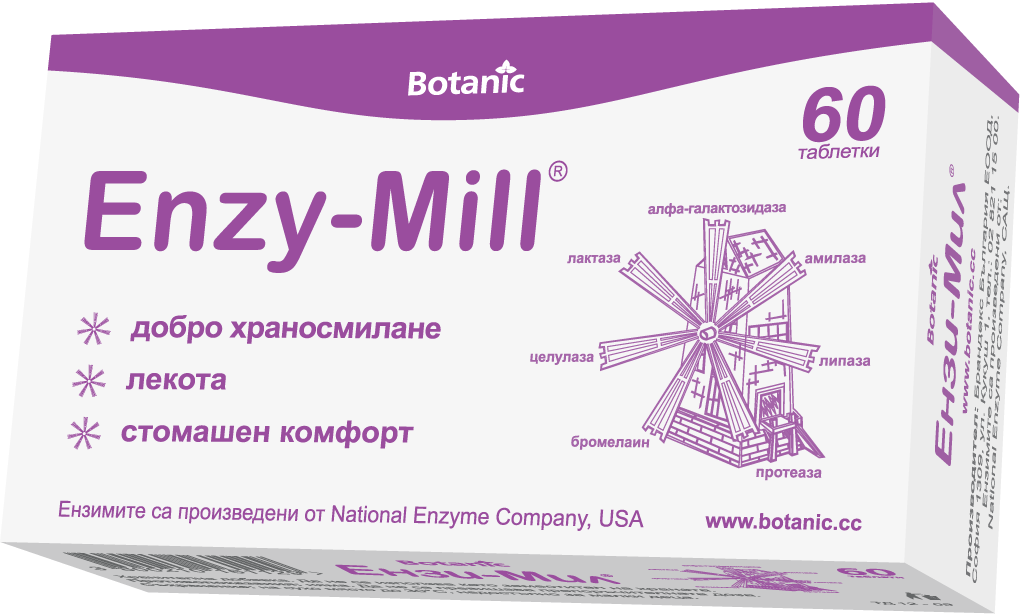
Enzy-Mill contains enzymes of plant origin: /products/enzymill/
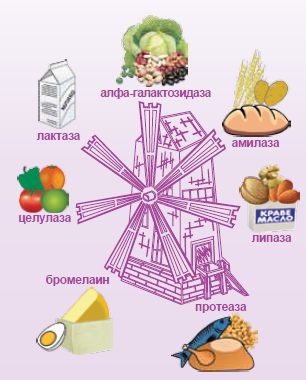
The most important digestive enzymes
Lipase
Lipase helps the body break down fats. Some medicines for weight loss block this enzyme precisely, but without lipase fats remain in our organism and settle in the arteries, which can lead to diseases of the cardiovascular system.
Enzy-Mill contains lipase: /products/enzymill/
Amylase
Amylase breaks down complex carbohydrates such as starches and glycogen. Foods that cause problems with digestion (for example bloating or heaviness in the stomach) usually require the intake of carbohydrates to cover the body’s energy needs. If these are not properly digested, a lack of amylase may be observed.
Enzy-Mill also contains amylase: /products/enzymill/
Protease
Protease is characterised by its ability to hydrolyse proteins in an acidic environment. There are different types of protease, depending on the kind of peptide bond they break.
Enzy-Mill also contains protease: /products/enzymill/
Bromelain
Bromelain supports the normal digestion and absorption of nutrients. It has a wide pH range and can be used as a substitute for pepsin and trypsin. It is extracted from pineapple and helps to break down proteins.
Enzy-Mill also contains bromelain: /products/enzymill/
Lactase
Lactase is the enzyme we need to break down lactose (milk sugar). Many adults have reduced lactase, so the body produces little of it. Symptoms of lactose intolerance most often appear after drinking fresh milk on an empty stomach. If within 30 minutes to 2 hours you notice bloating, rumbling, diarrhoea, gas or muscle cramps, that may be lactose intolerance. When lactase activity is insufficient to process the lactose, it passes into the large intestine, where it is turned into a nutrient substrate for various micro-organisms. This is linked to increased gas formation, fermentation, pain in the stomach and diarrhoea. In sour milk, lactose is broken down to a greater extent by Lactobacillus bulgaricus and other beneficial bacteria.
Enzy-Mill also contains lactase: /products/enzymill/
Cellulase
Cellulase breaks down cellulose (insoluble fibre). We need it when consuming vegetables, fruit and whole-grain products.
Enzy-Mill also contains cellulase: /products/enzymill/
Alpha-galactosidase
Alpha-galactosidase helps break down complex carbohydrates such as raffinose, stachyose and verbascose. These are not broken down in the stomach, so they cause bloating. Beans and pulses contain them, which is why they are consumed by the body with difficulty. Enzymes from the first two sources are more stable across the changing conditions of the stomach acid, and the body needs this enzyme to reduce discomfort after eating beans, cabbage, onions and garlic.
Enzy-Mill also contains alpha-galactosidase: /products/enzymill/
How do we tell whether the enzyme supplement we take works?
Many people notice the difference after the first tablet, while other results appear after a week of use. It improves metabolism and the digestive process. The absence of symptoms such as heaviness in the stomach, acid reflux or gases after large meals is a positive sign. You also notice an overall increase in energy, improved skin condition, and that you look and feel younger. Everything a person consumes but cannot process is reflected in the skin and the waistline.
It is important to remember that all of life’s processes are dependent on enzymes. Therefore, we cannot without reason call them “the elixir of life”.
Do not forget that the food that best reflects the body’s needs is the healthy food!
Enzy-Mill is a trusted natural product that contains the most important enzymes for digestion.
Learn more about Enzy-Mill!
Share the article:
Latest articles
Memory
There are many types of memory, from short-term and sensory memory to associative forms. Here is how we learn, store and recall information.
Amylase
Amylase is an enzyme secreted by the pancreas and the salivary glands. It begins breaking down starch in the mouth, turning complex carbohydrates…
Comments