Benign Prostatic Hyperplasia (BPH)
· 11 min read

What is BPH
The prostate consists of two types of glands: periurethral (located around the urethra) and peripheral. Benign prostatic hyperplasia (BPH, also known as prostate enlargement) is a non-cancerous increase in the number of glandular cells that surround the urethra.
BPH is one of the most common health conditions in men. The symptoms are more pronounced the greater the enlargement of the prostate and the resulting narrowing of the urethra. Some men have a wider urethra and therefore no symptoms at all. In others, and in the least common cases, the enlargement can lead to difficulties with urination.
The causes of its onset and development are not yet fully understood. It is thought to be complex and to depend on many factors: hormones, age, genetic factors, and lifestyle, including diet, the living environment and more.
After the age of 40, men's testosterone levels gradually decline, while the level of oestrogens (female sex hormones) remains the same or increases relative to testosterone. An increase in oestrogen levels is a very common occurrence. The cause is the presence of so-called xenoestrogens (or false oestrogens).
The most common culprits are the various derivatives of petrochemicals: pesticides, plastics, emulsifiers (contained in almost all cosmetic products), meat from animals treated with oestrogenic preparations to promote weight gain. All oestrogens are toxic, and the majority of them have oestrogenic effects on both male and female bodies.
Detoxification of oestrogen takes place in the liver. Its overload due to the above-mentioned toxins additionally contributes to increased oestrogen levels, and beyond that, to the potential risk of BPH for the prostate.

Statistics
- About 25% of men over the age of 40 suffer from the condition;
- As many as 50% of men over the age of 50;
- Up to 80% over 60 years of age, and over 90% of men over 80;
- Only 5.6% of men aged 40-70 consult a urologist about their urinary problems.
Symptoms
The symptoms are more pronounced the greater the enlargement of the prostate and the resulting narrowing of the urethra. Some men have a wider urethra and therefore no symptoms at all. In others, and in the least common cases, the enlargement can lead to difficulties with urination. The symptoms manifest as:
- Frequent night-time urination;
- Frequent urination during the day;
- Difficulty starting to urinate;
- Reduced amount and force of the urine stream.
To pinpoint the exact symptoms of the disease, the International Prostate Symptom Score (IPSS) has been created. It is completed independently by the patient and gives a quantitative assessment of the symptoms caused by benign prostatic hyperplasia (BPH). Above all, it gives the opportunity to assess the results of treatment.
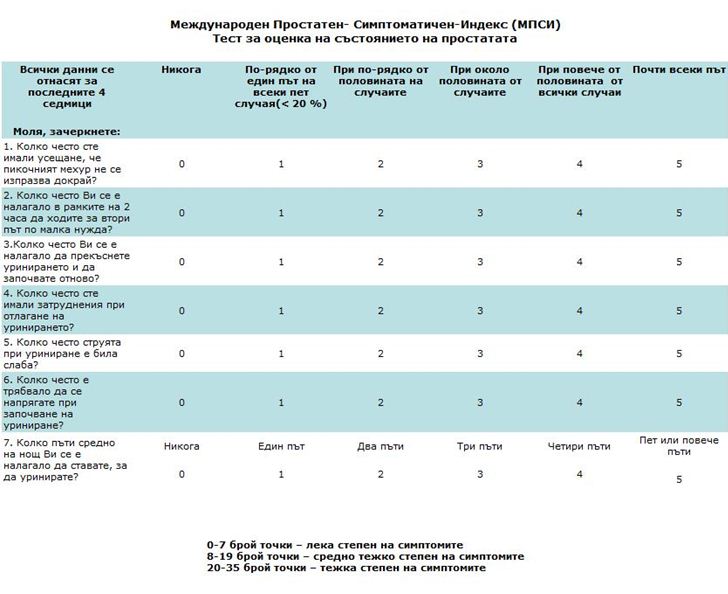
International Prostate Symptom Score (IPSS)
Causes of BPH
The causes of the onset and development of BPH are not yet fully explained. It is thought that the pathogenesis and aetiology of the disease are complex and depend on many factors: hormones, age, genetic factors, and lifestyle – diet, living environment and more.
- The cellular growth is stimulated by the conversion of testosterone in the prostate to DHT (dihydrotestosterone – a highly active form of testosterone), under the influence of the enzyme 5-α-reductase.
- Another cause is the conversion of testosterone into oestrogen, under the influence of the enzyme aromatase, which also affects the growth of the epithelial cells of the prostate.
- The assumptions for a link between BPH and sexually transmitted diseases, stones in the prostate, sclerotic changes in the area of the bladder neck and kidney disorders have not yet been confirmed.
Factors that contribute to the development of BPH
- After the age of 40, men's testosterone levels gradually decline, while the level of oestrogens (female sex hormones) remains the same or increases relative to testosterone. The cause is the presence of so-called xenoestrogens (or false oestrogens). The most common culprits are the various derivatives of petrochemicals: pesticides, plastics, emulsifiers (contained in almost all cosmetic
products), meat from animals treated with oestrogenic preparations to promote weight gain. All oestrogens are toxic, and the majority of them have oestrogenic effects on both male and female bodies. - An increase in oestrogen levels is a very common occurrence.
- Detoxification of oestrogen takes place in the liver. Its overload due to the above-mentioned toxins additionally contributes to increased oestrogen levels, and beyond that, to the potential risk of BPH for the prostate.
Complications
- Acute urinary retention – a sudden, painful inability to urinate. Urgent consultation with a urologist is needed. Catheter insertion may be necessary.
- In some men with an enlarged prostate, recurrent urinary tract infections are observed.
- Stones in the bladder – these may cause infection, irritation of the bladder, blood in the urine, difficulty urinating and more. The main reason for their formation is the inability to fully empty the bladder.
- Thickening of the bladder wall – high pressure in the bladder, due to difficulty passing urine, may directly damage the bladder or allow infections from the bladder to reach the kidneys. When the enlarged prostate causes bladder retention, it may progress to a condition called hydronephrosis – dilation of the structures that collect urine in one or both kidneys.
How BPH is diagnosed
- Your doctor will ask you to complete the questionnaire – IPSS, to establish the initial condition.
- Echography of the full bladder. It follows the normal dimensions of the prostate, which are approximately 2–3 cm.
- Rectal examination – this investigation allows the specialist to describe the prostate through palpation of its tissue in the rectum. It also determines the size, shape, consistency and relationship of the prostate directly to the surrounding tissues and organs.
- Urine analysis – can help to exclude infection or other conditions that may cause similar symptoms.
- Blood test for Prostate-Specific Antigen (PSA). Normally the prostate produces prostate-specific antigen (PSA), which helps to liquefy the sperm. When you have an enlarged prostate, PSA levels are raised.
- Uroflowmetry is a test that measures the quantity, speed and time for which the urine is released. It is possible to assess the complete use of the bladder. Most often it is done with the help of ultrasound, and the residual urine in the bladder is measured.
- Transrectal echography. The ultrasound examination determines the volume of the prostate and describes in detail the anatomy of the prostate gland.
Treatment of benign prostatic hyperplasia
Progression of BPH significantly affects the quality of life of men, but it is often a manageable condition.
In case of mild enlargement of the prostate and absence of severe symptoms, the approach is often gradual. It may consist of several measures, depending on the size of the enlargement, the presence of complications and the overall health of the patient:
- Reduce your consumption of caffeine, spicy foods and alcohol.
- Choose foods rich in zinc (pumpkin seeds, root vegetables, wholegrains). Their deficiency is linked to the prostate. It has been found that normally the prostate contains several times more zinc than any other organ in the human body. Studies show that zinc blocks the conversion of testosterone to dihydrotestosterone.
- Lycopene from tomatoes supports the healthy structure of the prostate. It has antioxidant and immunomodulating effects. It is found mostly in Brazilian nuts.
- Eat moderate amounts of lean meat and fish, and avoid oily and processed foods.
- Regular physical activity helps to maintain healthy circulation and a normal weight.
- Avoid sitting for long periods of time.
- Consider maintaining a healthy weight and a diet rich in vegetables and fruits.
- You can supplement zinc and vitamin C in organic forms through ZinSeD. Learn more: /products/zinsed/
In case of severe symptoms classical medicine prescribes medicines that relax the muscles of the prostate and the bladder and reduce the frequency of urination. There are two types of medicines prescribed for BPH:
- Alpha-blockers relax the smooth muscle of the prostate, the bladder neck and the urethra. These medicines are not equally effective for everyone. Some of the side effects include dizziness, low blood pressure and fatigue.
- Inhibitors block the activity of the enzyme 5-alpha-reductase, which converts testosterone into dihydrotestosterone. As a result, the enlarged prostate may shrink by 20% and the suffering is alleviated. These medicines also do not help all patients. Side effects include loss of sexual desire, difficulty achieving erection, and problems with ejaculation.
Treatment of severe forms beyond classical medicine is operative. It may be necessary in several ways, depending on the size of the enlargement and eventual complications in the condition (the size of the prostate, stones in the bladder and the overall health status of the patient).
Phytotherapy
- Pygeum (Pygeum Africanum) has an effect in the treatment and profilactic of benign prostatic hyperplasia. It inhibits the growth of the epithelial cells of the prostate, acts diuretically and immunostimulating.
- Palmetto saw palmetto (Serenoa Repens ) is used to support enlarged and weakened prostates, and to help with urinary flow. It reduces the sensitivity of the prostate to hormones.
- Willowherb (Epilobium parviflorum, Epilobium angustifolium) has a strong effect on the prostate. Epilobium parviflorum helps to maintain the health of the prostate. The compounds in the herb are active substances that, on the one hand, inhibit the enzyme aromatase, which converts testosterone into oestrogen, and on the other – inhibit the enzyme 5-α-reductase, which converts testosterone into dihydrotestosterone,
which can lead to changes in the prostate. Only this prevents and helps to slow the growth of the epithelial cells themselves. The herb also has diuretic and anti-inflammatory properties. It supports the entire urinary system. - Dandelion root helps maintain healthy hormonal levels, only this has a diuretic and anti-inflammatory effect.
- Peter Dimkov recommends the following combination of herbs: roots of valerian, golden rod, roots of birch and magdanoz.
- The leaves of horsetail act antibacterially and as cleansing agents. They also have diuretic action and support the urinary tract.
- Repeat supports the health of the prostate and balances hormones.
- Tiny seeds are rich in zinc, as well as useful amino acids – glycine, alanine and glutamine.
- Brazilian nut is rich in selenium, beneficial for the activity of the prostate.
- Linseed is rich in omega-3 fatty acids, which support the proper balance of hormones.
Advice to support prostate health
- Avoid physical overloads, especially when your bladder is full.
- Avoid delaying urination.
- Follow your regular bowel movement schedule. Constipation could aggravate negative symptoms.
- Limit your intake of nasty fats – red meat, fried food.
- Reduce the intake of alcohol and tobacco. Alcohol leads to a deficiency of zinc in the body.
- Avoid tight clothes and cycling, which can compress the prostate.
- Drink more water and teas.
- Vegetarian diets reduce the intake of artificial hormones, with which farm animals are fed, which would reduce the risk of hyperplasia of the prostate.
- Eat a varied diet rich in zinc, vitamins A, E, C and beta-carotene. Eat more fruits, vegetables and nuts.
- Protect yourself from excessive heat; excessive exposure to heat may disrupt hormonal balance in the body.
- Fibres, of which vegetables, fruit and wholegrain foods are rich, remain undigested in the digestive tract, and in this way they eliminate excess hormones, separated in the liver. Thus they leave the body more easily through the stool and are not reabsorbed, supporting hormonal balance.
- Light physical exercises are useful for the prostate, because they stimulate blood flow in the area of the pelvis. Avoid prolonged immobility.
- Practise Kegel exercises, which strengthen the pelvic floor muscles.
ProstaRen
ProstaRen is a specially developed synergistic formula from high-quality extracts of Tenolistna and Drebnotsvetna Varbovka, Grozdovo seme and organic Selen in the most easily absorbed form L-Selenomethionine. They act beneficially together on various symptoms associated with the disorders of the prostate. They support the healthy growth of the epithelial cells; support the natural function of the prostate at different levels; act anti-inflammatory and antibacterial; and are traditionally used against urinary disorders.
ProstaRen (ProstaRen) may be used as a supplement to conventional treatment, or as an alternative to it. With ProstaRen, the undesirable side effects that often follow long-term medical treatment or surgical intervention are limited. It contains no animal products, dyes or preservatives.
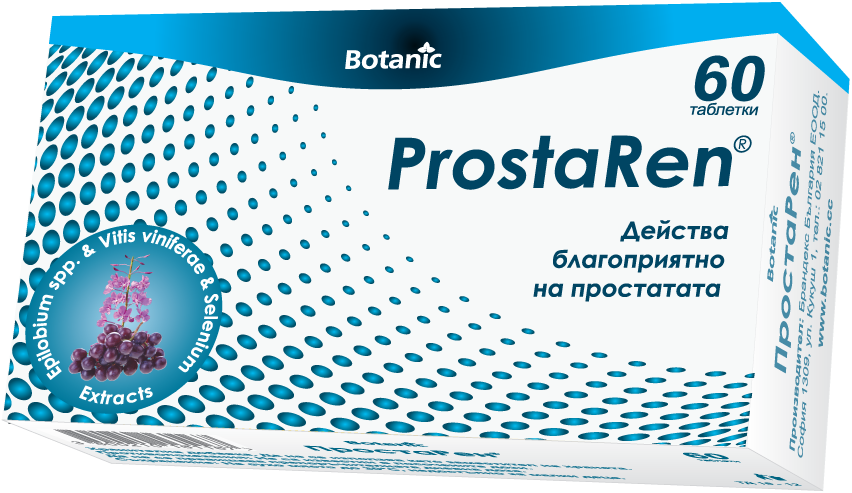
Find out more about ProstaRen!
Conclusion
Benign prostatic hyperplasia (BPH) is a common condition in men, particularly with advancing age. Early diagnosis and an appropriate treatment plan can significantly reduce symptoms and improve quality of life. Traditional treatment methods and natural products such as ProstaRen may be useful for supporting prostate health, offering a natural alternative or complement to classical medicine. Maintaining a healthy lifestyle, including proper diet and regular physical activity, plays a key role in prevention and in managing this condition.
Read more
Share the article:
Latest articles

Memory
There are many types of memory, from short-term and sensory memory to associative forms. Here is how we learn, store and recall information.
Amylase
Amylase is an enzyme secreted by the pancreas and the salivary glands. It begins breaking down starch in the mouth, turning complex carbohydrates…
Comments